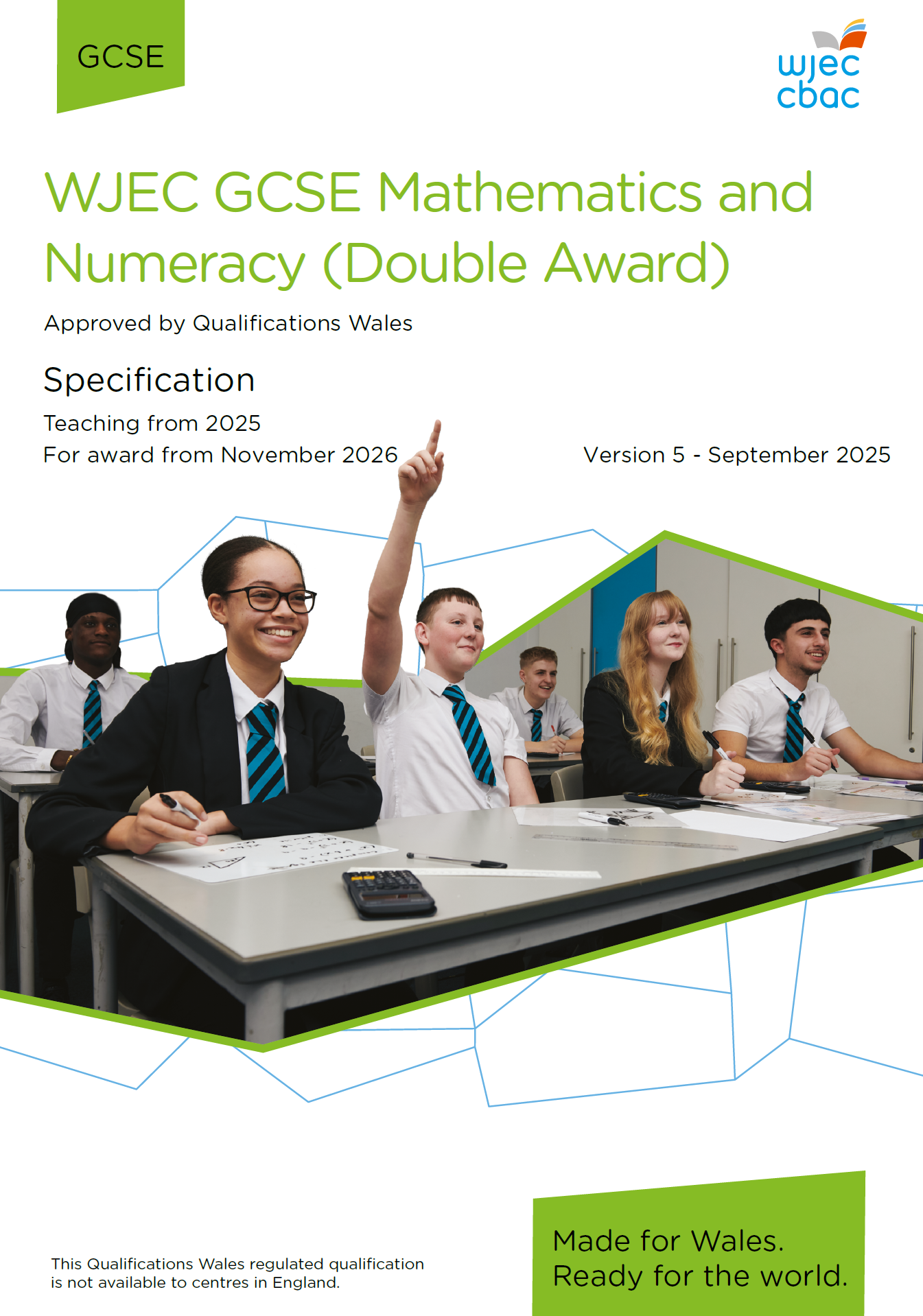
GCSE Mathematics and Numeracy (Double Award – WJEC)
Teaching from September 2025 | First awarded November 2026
What is GCSE Mathematics and Numeracy (Double Award)?
GCSE Mathematics and Numeracy (Double Award) is a core qualification that develops students’ confidence and competence in mathematics and its use in real-life situations. It leads to two GCSE grades and is a requirement for continued education, training and employment pathways in Wales.
The course places a strong emphasis on problem-solving, reasoning and practical application, helping learners understand how mathematics supports everyday life, the workplace and further study.
This qualification is approved by Qualifications Wales and fully aligned with the Curriculum for Wales.
What will students learn?
Students study mathematics across three interconnected units, covering the full breadth of GCSE mathematics while developing strong numeracy skills.
1. Financial Mathematics and Applications of Numeracy
This unit focuses on applying mathematics to real-world and personal contexts, including:
- Budgeting and personal finance
- Wages, payslips, tax, savings and loans
- Interest, discounts and financial comparisons
- Using mathematics to solve everyday problems
A calculator is allowed in this exam.
2. Non‑Calculator Mathematics
This unit builds fluency, accuracy and confidence without the use of a calculator. It includes:
- Algebra and equations
- Geometry and angle reasoning
- Probability
- Mental and written calculation skills
This unit strengthens core mathematical understanding and reasoning.
3. Calculator‑Allowed Mathematics
This unit includes topics best assessed with a calculator, such as:
- Statistics and data handling
- Measures, area and volume
- Trigonometry and graphs
- Problem‑solving using mathematical models
It links directly to real-life data, interpretation and decision‑making.
Key mathematical areas covered across the course
- Number and finance
- Algebra
- Geometry and measures
- Statistics and probability
Students also develop important mathematical skills, including:
- Logical reasoning
- Problem‑solving strategies
- Accurate communication and explanation
- Using mathematics in unfamiliar contexts
How is the course assessed?
The qualification is assessed through three written examinations:
- Unit 1 – Financial Mathematics
- 30% of the qualification
- Calculator allowed
- Unit 2 – Non‑Calculator
- 30% of the qualification
- Calculator not allowed
- Unit 3 – Calculator‑Allowed
- 40% of the qualification
There are two tiers of entry:
- Foundation Tier: Grades C–G
- Higher Tier: Grades A*–D
Students may be entered for different tiers in different units, allowing appropriate challenge and support.
Why study Mathematics and Numeracy?
GCSE Mathematics and Numeracy:
- Is essential for further education, apprenticeships and employment
- Develops skills needed for everyday life such as budgeting, interpreting data and problem-solving
- Supports progression to A level Mathematics and other subjects
- Builds resilience, independence and critical thinking
Mathematics is widely regarded as one of the most important qualifications by sixth forms, colleges, universities and employers.
Who is this course for?
This qualification is studied by all learners in Years 10 and 11. It is suitable for students with a wide range of abilities and backgrounds, with tiered assessments ensuring fair access and appropriate challenge.
No additional prior learning is required beyond Key Stage 3 mathematics.
Key information at a glance
- Qualification: WJEC GCSE Mathematics and Numeracy (Double Award)
- Grades awarded: Two GCSE grades (e.g. AA, BB, CC)
- Duration: 2 years (Years 10 and 11)
- Assessment: 3 written exams
- Calculator use: Yes (Units 1 and 3) / No (Unit 2)
Key Stage 4
- Art and Design
- Business Enterprise Skills
- Computer Science
- Criminology
- Design and Technology
- Digital Technology
- Engineering
- English Language and Literature
- Geography
- Hairdressing
- Health and Social Care, and Childcare
- History
- Hospitality and Catering
- Mathematics and Numeracy
- Performing Arts
- Physical Education and Health
- Religious Studies
- Science – Double
- Science – Biology
- Science – Chemistry
- Science – Physics
- Spanish
- Welsh
- Useful Resources from Hwb