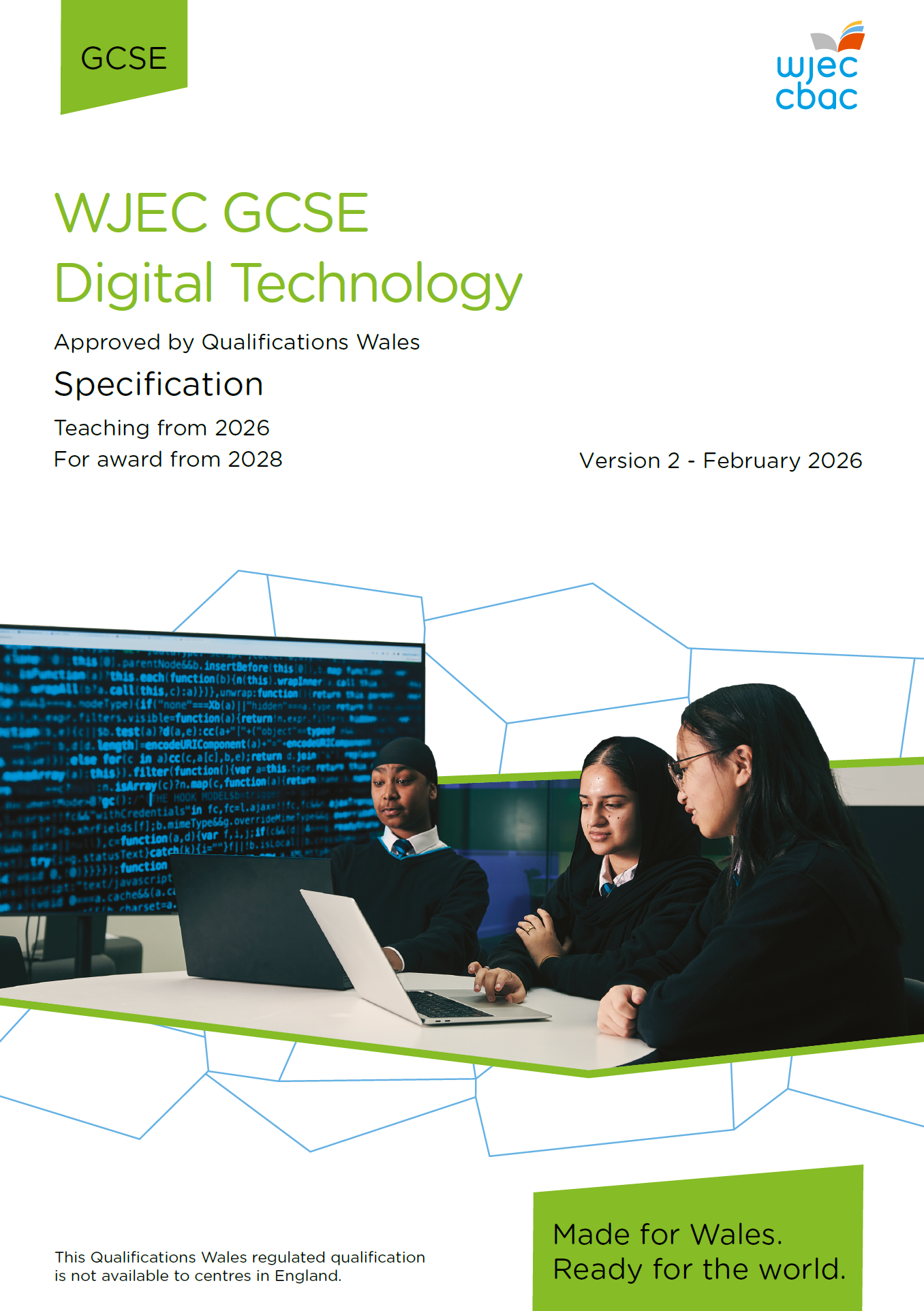
GCSE Digital Technology
Teaching from September 2026 | First award Summer 2028
Made for Wales. Ready for the world.
What is GCSE Digital Technology?
GCSE Digital Technology helps students understand how digital systems work, how data is used, and how digital products are designed, developed and evaluated. The course combines technical understanding with creative, practical skills, preparing learners to be confident users and creators of modern digital technologies.
It is fully aligned with the Curriculum for Wales and focuses on how technology impacts individuals, organisations and society.
What will students study?
The qualification is made up of three units, combining an exam with practical project‑based assessments.
Unit 1: The Digital World
Written examination – 40% of the GCSE
This unit builds understanding of how digital systems function and evolve. Students study:
- How data is measured, stored and compressed
- Analogue and digital data (images, sound and video)
- Digital devices, networks and operating systems
- Software types (system, application, bespoke vs off‑the‑shelf)
- Cloud computing and data backup
- Cyber security threats and data protection
- Digital footprints and online safety
- Legal and ethical responsibilities (e.g. data protection laws)
- Emerging technologies such as AI, IoT, VR and machine learning
Unit 2: Digital Practices
Non‑examination assessment – 40% of the GCSE
This unit focuses on creating digital products in response to a real‑world client brief set by WJEC. Students will:
- Clean, organise and analyse quantitative data
- Use data to identify audience needs and trends
- Propose, design and justify digital product ideas
- Develop two digital products, including:
- a multi‑page website
- either a computer game or a 2D animation
- Test and evaluate the effectiveness of their products and development process
This unit develops strong problem‑solving, planning and technical skills.
Unit 3: Communicating in the Digital World
Non‑examination assessment – 20% of the GCSE
In this unit, students explore digital marketing and communication. They will:
- Investigate social media platforms and target audiences
- Understand digital marketing strategies, opportunities and risks
- Create and manipulate digital media assets (images, video, graphics, text)
- Plan and produce a digital marketing campaign video
- Evaluate how effectively their campaign meets its aims
How is the course assessed?
- 1 written exam (Unit 1)
- 2 practical non‑examined assessments (Units 2 and 3)
- No tiering – all students study the same course
- Marks reward creativity, technical accuracy, analysis and evaluation
What skills does Digital Technology develop?
GCSE Digital Technology helps students to:
- Understand how digital systems and data work
- Think logically and analytically
- Design and create digital products
- Solve real‑world problems using technology
- Work independently and collaboratively
- Develop transferable digital skills valued by employers
Who is GCSE Digital Technology for?
This course is ideal for students who:
- Enjoy working with computers and digital tools
- Are creative and enjoy designing and making things
- Are interested in technology, gaming, media or digital careers
- Want a practical subject with real‑world applications
No additional prior knowledge is required beyond Key Stage 3.
How does this subject support future pathways?
GCSE Digital Technology provides a strong foundation for:
- AS/A level subjects such as Computer Science, ICT or Media Studies
- Further study in digital, creative or technical courses
- Careers in areas such as:
- software and web development
- digital media and marketing
- gaming and animation
- cyber security and data roles
Key information at a glance
- Qualification: WJEC GCSE Digital Technology
- Duration: 2 years (Years 10 and 11)
- Assessment: Exam (40%) + NEA (60%)
- Focus: Data, digital systems, product design and digital communication
Key Stage 4
- Art and Design
- Business Enterprise Skills
- Computer Science
- Criminology
- Design and Technology
- Digital Technology
- Engineering
- English Language and Literature
- Geography
- Hairdressing
- Health and Social Care, and Childcare
- History
- Hospitality and Catering
- Mathematics and Numeracy
- Performing Arts
- Physical Education and Health
- Religious Studies
- Science – Double
- Science – Biology
- Science – Chemistry
- Science – Physics
- Spanish
- Welsh
- Useful Resources from Hwb