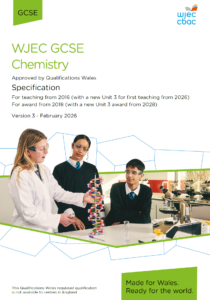
GCSE Chemistry (Triple Science) – Course Overview
Exam board: WJEC
GCSE Chemistry is studied as part of our Triple Science pathway, where students achieve separate GCSEs in Biology, Chemistry and Physics. This course provides a deeper and more detailed understanding of chemical processes and the material world.
What will students learn?
Students explore the structure, properties and reactions of substances, including:
- Chemical substances and reactions – elements, compounds, mixtures and how substances interact
- Atomic structure and the periodic table – how atoms are organised and how this affects properties
- Energy and rates of reaction – how and why reactions happen
- Chemical bonding – how atoms join and how this influences material properties
- Acids, bases and salts – reactions and applications in real life
- Organic chemistry – fuels, hydrocarbons and plastics
- The Earth and resources – atmosphere, water and sustainability
Learning is linked to real-world applications, including energy use, environmental issues, materials science and industrial processes.
Skills students will develop
Students will build a range of important skills, including:
- Practical and investigative (scientific enquiry) skills
- Problem solving and analytical thinking
- Data handling and mathematical skills
- Understanding scientific methods and evidence
- Clear communication using scientific terminology
Practical work is a key part of the course and supports understanding of theoretical concepts.
How is the course assessed?
The GCSE Chemistry qualification consists of three units:
- Unit 1: Chemical substances, reactions and essential resources (exam) – 45%
- Unit 2: Chemical bonding, applications and organic chemistry (exam) – 45%
- Unit 3: Scientific enquiry (practical investigation + written task) – 10%
Students complete a combination of written exams and practical-based assessment.
Students are entered for either:
- Higher Tier (grades A–D)*
- Foundation Tier (grades C–G)
Each science is awarded as a separate GCSE grade within the Triple Science pathway.
Course structure
- Year 10: Core topics such as atomic structure, reactions and the Earth’s resources
- Year 11: More advanced content including bonding, organic chemistry and industrial processes, alongside practical enquiry
The course is structured to build knowledge progressively and develop strong scientific understanding.
Why choose Triple Science (Chemistry)?
Studying Chemistry as part of Triple Science:
- Provides a deeper and more detailed understanding than Double Award Science
- Supports progression to A level sciences and further study
- Develops strong practical and analytical skills
- Opens pathways into careers such as engineering, medicine, environmental science and chemical industries
Learning beyond the classroom
Students may also have opportunities to:
- Carry out practical experiments and investigations
- Explore real industrial and environmental applications
- Analyse scientific data and trends
- Develop teamwork and independent learning skills
In summary
GCSE Chemistry (Triple Science) offers a challenging and engaging course, helping students understand the materials that make up our world and how science is used to solve real-life problems.
Key Stage 4
- Art and Design
- Business Enterprise Skills
- Computer Science
- Criminology
- Design and Technology
- Digital Technology
- Engineering
- English Language and Literature
- Geography
- Hairdressing
- Health and Social Care, and Childcare
- History
- Hospitality and Catering
- Mathematics and Numeracy
- Performing Arts
- Physical Education and Health
- Religious Studies
- Science – Double
- Science – Biology
- Science – Chemistry
- Science – Physics
- Spanish
- Welsh
- Useful Resources from Hwb