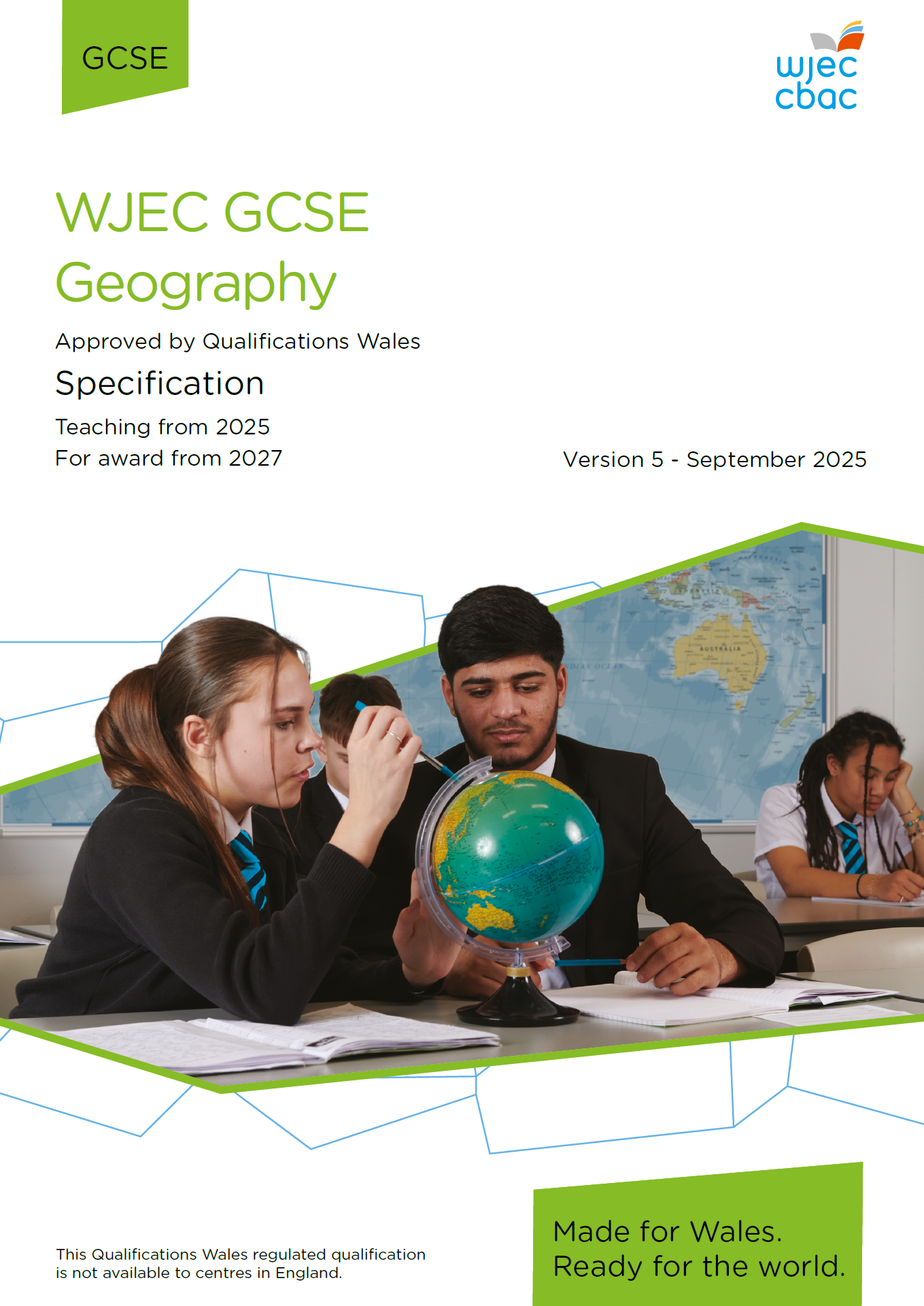
GCSE Geography (WJEC)
Teaching from September 2025 | First award Summer 2027
Made for Wales. Ready for the world.
What is GCSE Geography?
GCSE Geography helps students understand how physical landscapes and human societies interact, and how the world is changing at local, national and global scales. The course develops curiosity about places and people, while building strong skills in analysis, enquiry, decision‑making and fieldwork.
The qualification is fully aligned with the Curriculum for Wales and places a strong emphasis on sustainability, inequality, climate change and global challenges.
What will students study?
The course is made up of four units, combining written examinations with fieldwork and decision‑making activities.
Unit 1: Our Physical and Human World
Written examination – 30% of the GCSE
This introductory unit builds key geographical knowledge and concepts. Students study:
- River landscapes and drainage basins
- Coastal processes and landforms
- Migration: causes, impacts and management
- Settlement change and global cities
- Physical and human processes shaping places in Wales and the wider world
Unit 2: Developing Fieldwork Skills
Non‑examination assessment – 25% of the GCSE
Fieldwork is central to GCSE Geography. In this unit students:
- Plan and carry out a fieldwork enquiry outside the classroom
- Collect primary and secondary data
- Use maps, GIS and data‑handling techniques
- Analyse patterns and trends
- Draw conclusions and evaluate their enquiry
This unit is set and marked by WJEC and develops strong investigative and practical skills.
Unit 3: Our Dynamic and Diverse World
Written examination – 30% of the GCSE
This unit focuses on global issues and interdependence, including:
- Inequality in Wales, the UK and globally
- Measuring development and the development gap
- Weather systems and climate patterns
- Extreme weather hazards
- Climate change: causes, evidence and impacts
- Managing global challenges, including threats to oceans
Unit 4: Sustainable Solutions
Non‑examination assessment – 15% of the GCSE
This unit develops decision‑making and problem‑solving skills. Students:
- Explore real‑world sustainability issues
- Understand the three pillars of sustainability (economic, social, environmental)
- Use evidence to evaluate different options
- Carry out a sustainability impact assessment
- Justify a final decision based on evidence
This assessment is set by WJEC, marked in school and moderated externally.
How is the course assessed?
- Two written examinations (Units 1 and 3)
- Two non‑examined assessments (fieldwork and decision making)
- No tiering – all students follow the same course
- Marks reward knowledge, application, analysis and geographical skills
What skills does Geography develop?
GCSE Geography helps students to:
- Understand complex global and local issues
- Analyse data, maps and geographical information
- Think critically and evaluate evidence
- Work independently through enquiry and fieldwork
- Develop strong written communication skills
These skills are highly valued by colleges, universities and employers.
Who should choose GCSE Geography?
Geography is ideal for students who:
- Are curious about the world and current issues
- Enjoy both physical and human geography
- Like learning through real‑world examples
- Want a subject that keeps future options open
No specific prior knowledge is required beyond Key Stage 3.
How does GCSE Geography support future pathways?
This qualification provides a strong foundation for:
- AS and A level Geography
- Subjects such as Environmental Science, Geology, Sociology and Economics
- Careers in environmental work, planning, sustainability, education, travel, research and many others
Key information at a glance
- Qualification: WJEC GCSE Geography
- Duration: 2 years (Years 10 and 11)
- Assessment: Exams (60%) + NEA (40%)
- Focus: Physical geography, human geography, fieldwork and sustainability
Key Stage 4
- Art and Design
- Business Enterprise Skills
- Computer Science
- Criminology
- Design and Technology
- Digital Technology
- Engineering
- English Language and Literature
- Geography
- Hairdressing
- Health and Social Care, and Childcare
- History
- Hospitality and Catering
- Mathematics and Numeracy
- Performing Arts
- Physical Education and Health
- Religious Studies
- Science – Double
- Science – Biology
- Science – Chemistry
- Science – Physics
- Spanish
- Welsh
- Useful Resources from Hwb