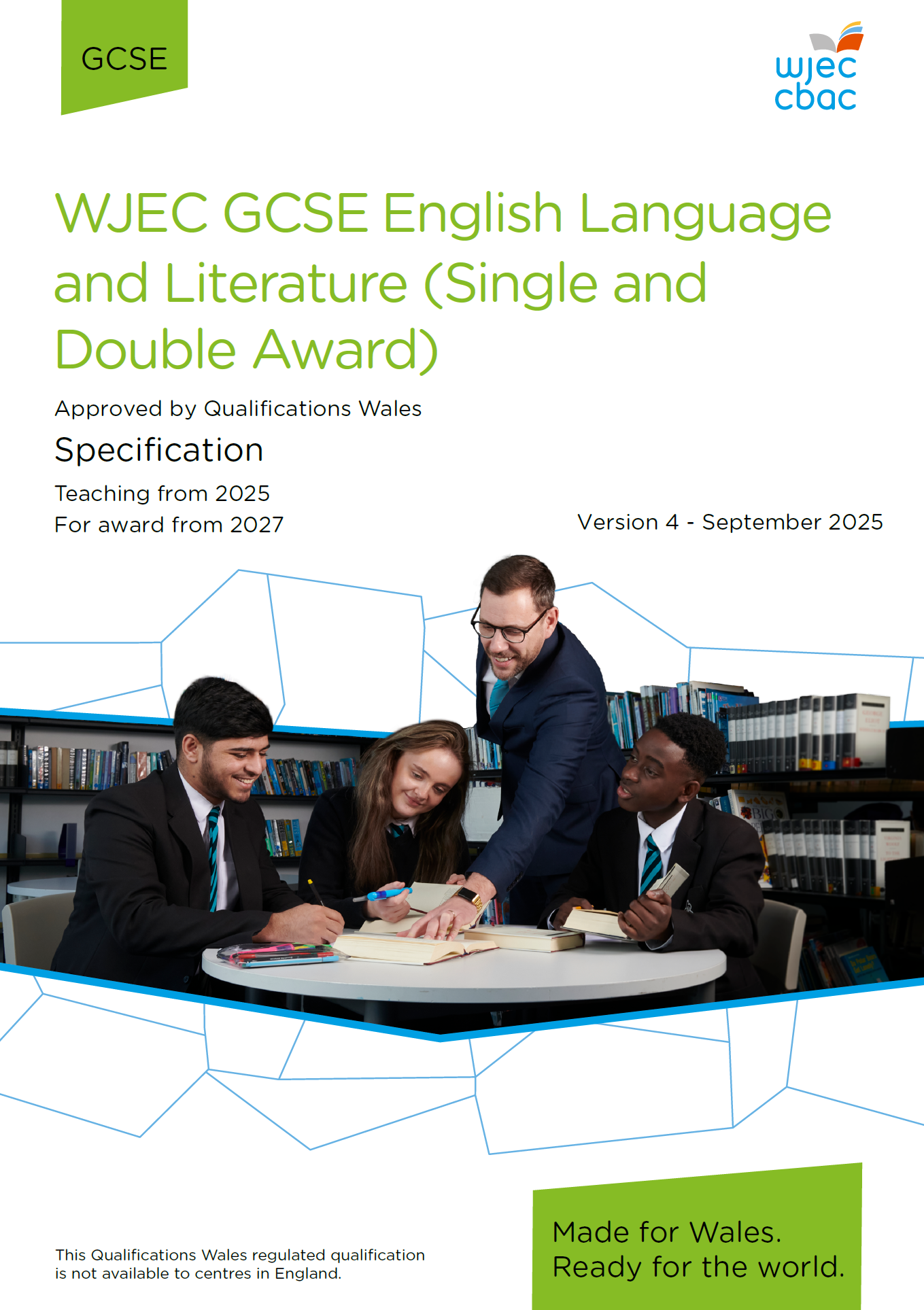
GCSE English Language and Literature (WJEC)
Single Award and Double Award
Teaching from September 2025 | First awarded Summer 2027
What is GCSE English Language and Literature?
GCSE English Language and Literature is an integrated qualification that combines the study of reading, writing and spoken communication, drawing on both literary and non‑fiction texts. Students develop essential skills in communication, critical thinking, creativity and empathy, all of which are vital for success in further education, employment and everyday life.
The course is fully aligned with the Curriculum for Wales and is approved by Qualifications Wales.
Single Award or Double Award – what’s the difference?
- Single Award: leads to one GCSE grade
- Double Award: leads to two GCSE grades and involves studying more texts in greater depth
Schools will guide students on the most appropriate route.
What will students study?
Students explore how language works and how writers create meaning across different texts, time periods and contexts. Key themes run throughout the course, including Belonging, Influence and Power, Motivations, Continuity and Change, and Connections.
Depending on the award taken, students will study a combination of:
Poetry
- Poems from the WJEC Poetry Anthology
- Unseen poetry
- Poetry from different periods, including pre‑20th century (Double Award)
Prose and Drama
- A modern prose text (e.g. novels exploring identity, community and belonging)
- A drama or prose text focusing on writers’ and characters’ motivations
- A whole Shakespeare play (Double Award only)
Non‑fiction
- A wide range of real‑world texts such as speeches, articles, blogs, transcripts and reports
- Texts linked to issues such as human rights, diversity, work, sustainability and global contexts
Speaking, listening and oracy
Oracy is a key feature of the course. Students will:
- Take part in group discussions
- Deliver an individual researched presentation
- Participate in paired discussions
These activities help students develop confidence, clarity and persuasive communication skills.
How is the course assessed?
Assessment is through a mix of examinations and non‑examination assessment (coursework).
Examinations
- Written exams test reading comprehension, analysis, comparison and writing skills
- Exams include both literary and non‑fiction writing tasks
Non‑examination assessment
- Extended written responses
- Spoken presentations and discussions
- Tasks are set nationally, marked by teachers and moderated by WJEC
There is no tiering – all students study the same standard.
What skills does this subject develop?
GCSE English Language and Literature helps students to:
- Communicate clearly and confidently in speech and writing
- Analyse and evaluate texts critically
- Write creatively and for real‑world purposes
- Understand different perspectives, cultures and contexts
- Develop empathy, confidence and independence
These are highly transferable skills, valued by colleges, universities and employers.
Who is this course for?
English Language and Literature is studied by all learners in Years 10 and 11. It supports:
- Progression to A level English and other subjects
- Success across the whole curriculum
- Preparation for life, work and further study
No additional prior learning is required beyond Key Stage 3 English.
Key information at a glance
- Qualification: WJEC GCSE English Language and Literature
- Awards: Single Award (1 GCSE) or Double Award (2 GCSEs)
- Duration: 2 years (Years 10 and 11)
- Assessment: Exams and non‑examination assessment
- Focus: Reading, writing, speaking and listening
Key Stage 4
- Art and Design
- Business Enterprise Skills
- Computer Science
- Criminology
- Design and Technology
- Digital Technology
- Engineering
- English Language and Literature
- Geography
- Hairdressing
- Health and Social Care, and Childcare
- History
- Hospitality and Catering
- Mathematics and Numeracy
- Performing Arts
- Physical Education and Health
- Religious Studies
- Science – Double
- Science – Biology
- Science – Chemistry
- Science – Physics
- Spanish
- Welsh
- Useful Resources from Hwb